









A granite floor can pass every strength and stain test and still fail the one test a hotel guest notices first: staying upright when the floor is wet. Slip resistance is the specification item most often left until after finishes have been chosen on appearance alone — by which point the only remedies left are a sealant or a mat.
Slip resistance is unusual among stone properties because the requirement comes from safety law and liability, not from the client's taste. Australia's model work health and safety framework, administered by Safe Work Australia, places a duty on businesses to minimise risks to health and safety, and slips on wet flooring are among the most frequently reported incident categories in hospitality premises. Comparable duties exist across Europe and North America.
Three factors compound the exposure for hotels:
There is no single global slip resistance number. Four test families dominate international specification, and they are not interchangeable.
A person wearing standardised footwear walks up and down a tilting ramp lubricated with motor oil. The angle at which they slip defines the classification, expressed as R9 to R13, where higher numbers indicate greater slip resistance. R9 is the lowest classified group, R13 the highest. This is the reference method for stone and tile floors in commercial buildings across Europe.
A spring-loaded rubber slider on a pendulum is swept across the wet surface, and the energy lost to friction produces a slip resistance value. AS 4586 expresses this as P0 to P5. Pendulum testing is widely used because it can also be performed on installed floors, which makes it the usual method for on-site verification.
Pool surrounds and shower floors are tested on an inclined platform with bare feet, producing A, B or C classifications, where C offers the highest slip resistance. A floor that performs well under the shod method will not automatically pass this test, because contact area and lubrication differ.
In the United States, slip resistance is usually specified through ANSI A326.3, which uses the DCOF AcuTest to measure the dynamic coefficient of friction. A widely applied minimum is 0.42 for level interior spaces walked on when wet. The older ASTM C1028 static friction test was withdrawn, so specifications that still call for a C1028 value should be updated.
Slip resistance follows surface texture far more closely than stone type. Polished granite and polished quartz can both be unsuitable for a wet bathroom floor, while the same granite finished differently can be acceptable outdoors.
| Surface finish | Typical wet classification range | Typical wet DCOF behaviour | Best suited areas |
|---|---|---|---|
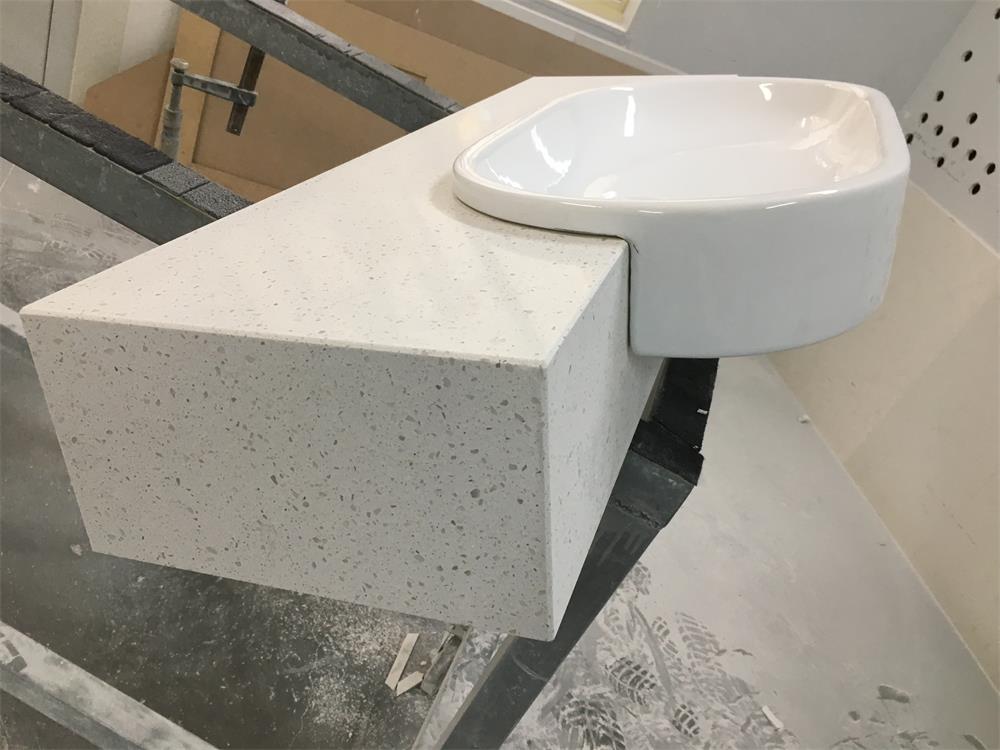
| Polished | R9 (lowest group) | Often below 0.42 | Dry lobbies, wall cladding, dry vanity tops |
| Honed | R9 to R10 | Borderline to acceptable | Guest bathroom floors, dry residential floors |
| Matte / leathered | R10 to R11 | Comfortably above 0.42 | Hotel bathrooms, kitchens, covered terraces |
| Brushed / sandblasted | R11 to R12 | High | Entrance areas, ramps, pool surrounds |
| Flamed / bush-hammered | R12 to R13 | Highest | External paving, steps, driveways |
Two cautions apply. These are typical industry ranges, not guarantees: a specific product's classification must be confirmed by test report, because aggregate hardness, resin content and texture depth all shift the result. DCOF and R values are also not convertible, so name the method as well as the number.
Guest bathroom floors are the highest-risk stone surface in a hotel. Honed or matte finishes in the R10 to R11 range are the usual specification, with a barefoot classification of B or C for shower floors. Polished stone is normally acceptable only where the floor is reliably dry, which in practice means it is not.
Barefoot wet areas require barefoot-rated material, so flamed, bush-hammered or sandblasted finishes are standard, because the texture survives chlorinated water and constant cleaning. Fewer joints also mean fewer interruptions to drainage falls.
Level, covered floors are normally specified with a wet DCOF of at least 0.42. Honed finishes handle lobby traffic well but need strict cleaning control, because polish residue is a common cause of a compliant floor failing on site.
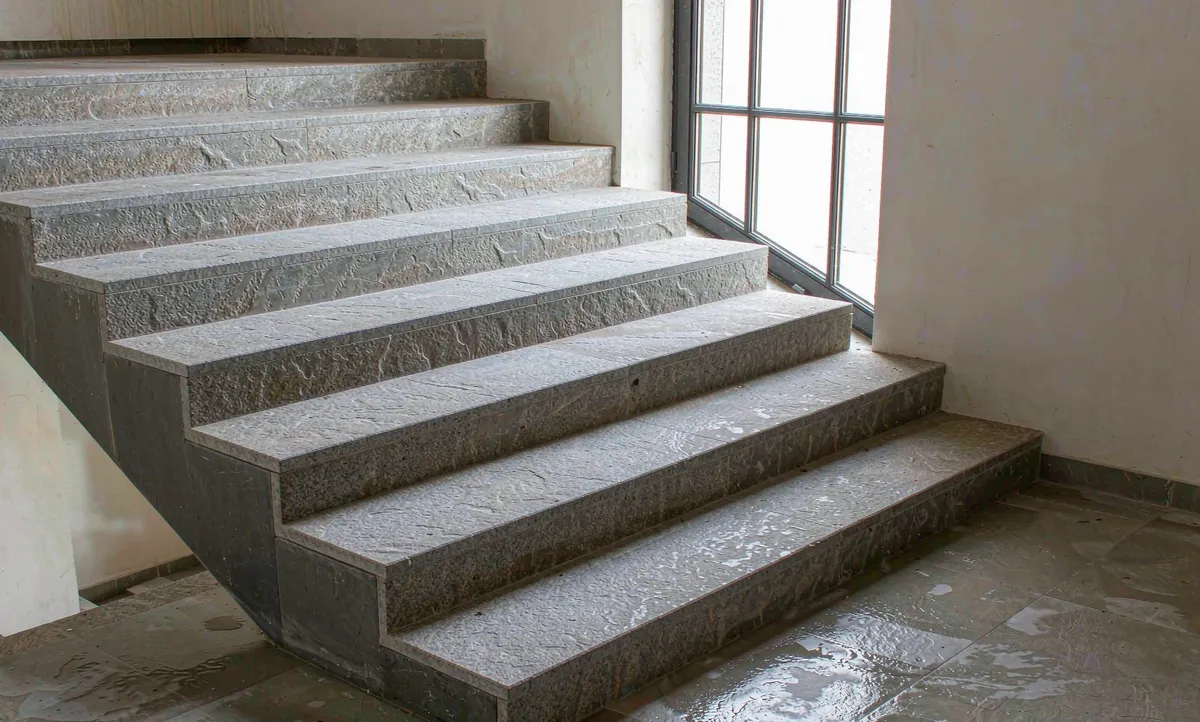
Stairs combine a sloped walking surface with concentrated loads and water carried in from outside. Treads are usually specified one classification higher than the adjacent floor.
Stone stairs are fabricated, so slip performance is partly designed in the workshop rather than selected from a catalogue.
Stair treads are cut from slab, so finish and edge profile must be fixed before slab cutting begins. Changing a tread finish afterwards usually means remaking the piece.
Slip resistance is not permanent. Maintenance can degrade it as easily as wear.
Honed and matte finishes in the R10 to R11 range are the common specification for guest bathroom floors, with shower floors also rated under the barefoot method. The exact requirement depends on local code and the client's risk assessment.
For reliably dry areas such as lobbies, wall cladding and dry vanity tops, yes. In wet areas it is normally not acceptable, because polished surfaces fall in the lowest slip resistance group.
No. DCOF comes from the AcuTest method referenced in ANSI A326.3 and behaves differently from the inclined platform test that produces R classifications. A project should state which method applies rather than converting between them.
Partially. Brushing, honing or grooving can be applied on site and anti-slip treatments exist, but results vary and the appearance of the floor changes. Specifying the correct finish at slab selection stage is far more reliable.
Far less than finish does. Two granites finished differently will differ more than two stone types finished identically. Hardness, grain and texture depth still cause measurable differences, so each product should be verified by test report.
Control cleaning: residue-free neutral cleaners, no film-forming polish, and re-testing after any deep cleaning or surface restoration.
YDL Stone supplies engineered quartz, granite, marble, quartzite and travertine in blocks and slabs for hotel and residential projects, with finishes produced to the texture depth a specification requires rather than to appearance alone. For slip-critical areas we can combine the finish, edge profile and fabrication detail, and coordinate test documentation and batch retention so the stone that arrives matches the stone that was approved.
If you are working on a project with wet floors, stairs or pool surrounds, send us the area schedule and target classification. Our team will recommend the finish, format, edge detail and QC checkpoints, and quote blocks or slabs accordingly.
Contact YDL Stone with your drawings and slip resistance requirement to request samples and a quotation.